Explore the platform
The tools behind connected patient care.
Explore lab history, daily briefings, protocols, clinical reviews and lab-order preparation. Features are grouped by workflow; upcoming capabilities are clearly marked in development.
Status: Practice demos are open. CHAI runs daily on its founder’s record, and we’re preparing our first practice deployments.
Jump to: Record & labs · Today · Daily read · Fitness & sleep · Nutrition · Biological age · Protocol · AI reviews · Requisition · Practice tools · How CHAI makes its work reviewable · In development
Record & labs
Lab history organized for meaningful comparison.
- Lab PDF importUpload the report; every marker on the page is stored under one standard name, with the lab's own label kept beside it. No fixed panel: what CHAI can read depends on what was drawn.
- Standard marker namesCHAI standardizes different names for the same marker while preserving the original lab label. Updated mappings also apply to historical results.
- Lab and method on every resultEach result keeps its lab, its test method and whether that method is good enough to act on. A trend is fitted within one test; other labs' results are shown, not averaged in.
- Lab concordanceA primary lab (Quest / Ulta) is the gold standard. A monthly direct-to-consumer panel is trusted only within tolerance of its own prior result, unless a protocol change explains the gap. Flagged, never silently excluded.
- Results beyond assay limits stay clearly markedA result reported as “>1500 ng/dL” remains above the assay’s reporting limit. It is excluded from statistical calculations that require an exact value.
- Marker targets with reasonsEvery target stores low, high, who set it and why. A constitutional low is labelled "your normal" instead of "below range".
- Eleven domain panelsLipids, hormones, thyroid, hematology, liver, renal, electrolytes, glycemic, inflammation, vitamins & minerals, prostate & cancer. Each with legend chips, the last-versus-prior arrow and "what changed" protocol events on the chart.
- Marker sheetTrend basis, slope, confidence, reference and target bands, the assay note, protocol events on the timeline, and an "Ask about this marker" button.
- Ask CHAI with computed statisticsNamed markers are resolved against the patient's own lab names; sample size, span, mean, median, min, max, slope per year and same-date Pearson r are calculated by CHAI itself and shown with the answer. The model quotes; it never recomputes.
- Evidence tilesEvery AI answer shows the sparkline tiles of the markers it cited, with draw count, span and reference range.
- Quest test-code libraryEach marker maps to its Quest test code, specimen, fasting requirement and category, so a requisition can be ordered by exact test name.
Today
Start with Today. Explore the full picture when you need it.
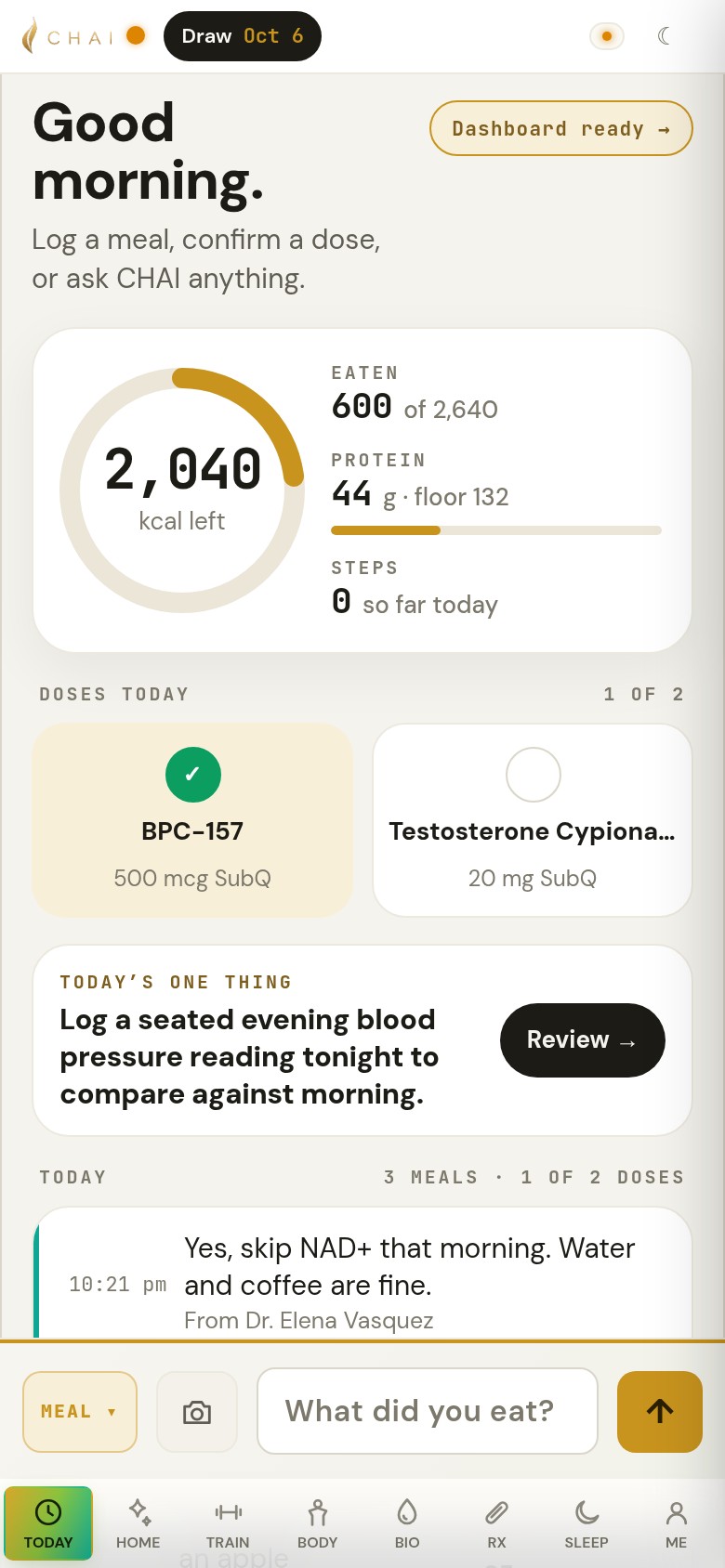
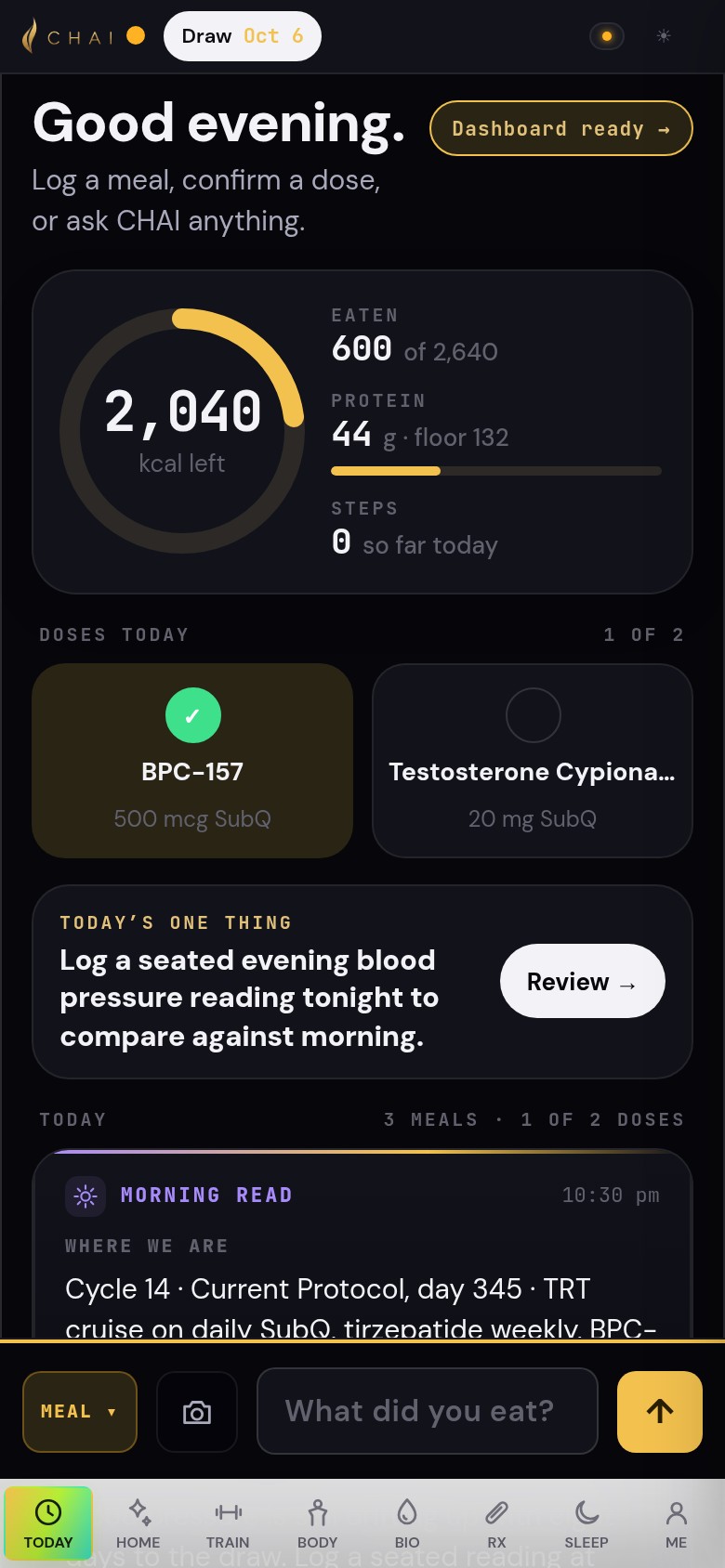
- The ledgerCalories left in a ring against the day’s ceiling, protein and steps against their floors, doses as tap cards, the one thing for today, and today’s entries as rows. The app opens here.
- One composer, three actionsLog a meal by text or photo, ask CHAI, or message the practice, from the same box. A follow-up about a meal logged today corrects that meal; a meal can be corrected or deleted from its entry.
- The practice conversationA patient writes from Today. The practice answers from the clinic page’s Inbox, and the reply appears on Today with the clinician’s name. Unread replies badge the Today tab; the alert email says only “You have a new message in CHAI. Sign in to read it.”
- The dashboard, behind itThe full record builds in the background and a pill says when it is ready; the calorie ring stays in the header on every other tab. Biological age and healthspan stay on the CHAI tab; the one thing is a row on Today and the full card on CHAI.
The daily read
What changed overnight, with the numbers it used.
- Morning PulseA daily summary with one priority, positive changes and findings to watch. Supporting tiles show the same seven-day and 30-day figures used in the briefing.
- Follow-up questions with real buttonsYes / No, a choice, or open text. Answers are stored and fed to tomorrow's read; answered questions never return.
- Today's signals stripHRV, resting HR, sleep, blood pressure, weight, VO₂ max, walking, steps and compliance as seven-day means against the thirty-day baseline, last reading underneath. Partial-day counts are labelled "so far today".
- Apple Health syncA native HealthKit bridge delivers resting and active heart rate, HRV, sleep with stages, steps, blood pressure, body fat, respiratory rate, glucose and more, deduplicated by timestamp and source, with a freshness badge and per-metric coverage.
- VO₂ max estimate and calibrationEstimated from wearables, labelled as an assumption until a calibration test replaces it.
- Morning check-inOvernight metrics auto-captured from Apple Health with a synced badge and the change against baseline; manual entry offered only for what didn't sync; one-tap "how's this morning" chips plus free text that feeds the day's read; an optional quick signal (bedtime, wake-ups, screens, libido, mood, appetite, water, missed-dose reason) whose questions adapt to the state of the record. Skipped check-ins trigger the evening follow-up.
- Symptom log with a 97-entry dictionaryEighteen categories, severity, notes. Every entry runs a correlation pipeline against the protocol, the biomarkers and wearables, and looks for patterns.
- Photo check-insPosed photos on a cadence, stored per patient, with an AI visual read on request.
- Goals and milestonesStored with the patient's history and mentioned in the daily read.
- Proactive outreach, three moments a day10:00 the day's read; 12:00 today's unlogged morning doses, the daily sexual-health question and draw reminders; 19:15 the multi-day backlog of unconfirmed doses and stale wearable syncs. Backs off when ignored, never gives up, quiet when nothing is outstanding.
- Dose confirmations in everyday language"All except Thursday's" is classified by a model that can only touch unconfirmed doses, asks again when ambiguous, and echoes back what it applied.
- Sexual wellness as a vital signMorning-erection rate over logged days against the prior period, activity frequency per 30 days against an observational reference, streaks and dry spells only when the days were logged; ten sexual-health symptoms in the dictionary, correlated with the protocol and the labs.
- Daily digestThe day's read and the dashboard numbers, posted to the practice's clinic page each morning.
Fitness and sleep
One Fitness tab: fuel and training read at a glance, informed by the protocol, the labs and recovery.
- The glanceOne band across the top of the Fitness tab: what went in, what goes out (BMR, activity and sessions), what is left today, protein against target and floor, weight to goal, today’s session, and CHAI AI’s line for the day.
- Fuel beside TrainToday’s meals, the floors and fourteen days of eaten against Apple Health burn on the same tab as the week’s prescription and today’s session. The Nutrition panel keeps the day-by-day history.
- Workouts logged by handFor the session the dead phone or watch never recorded: type, date, minutes, an optional average heart rate. Counted in the week, the load chart and the fuel ceiling; a hand log within thirty minutes of a watch workout is shown but not counted twice.
- Easy walks kept honestA walk, hike or run averaging under 60% of maximum heart rate counts for burn and steps, never as zone 2.
- Training phases (arcs)A span of weeks with a purpose (Build, Cut, Aerobic base, Cruise, Recovery, Travel), a prescription, a photo check-in cadence and gates. Blast weeks map to a Build arc with a Recovery arc for the last two; a cruise maps to a Cruise arc.
- PrescriptionSessions per week by type with minutes (strength, zone 2, Norwegian 4×4, mobility) and a daily step floor, from templates seeded from real training splits, editable per arc.
- Gates from the labsUric acid under 2.5 blocks 4×4; seven-day HRV under 80% of the 30-day baseline downgrades intensity; hematocrit at 52 or above blocks the VO₂ test. The plan shows the gate and the value that tripped it.
- This week and todaySessions done against prescribed, minutes done, step days at the floor, and today's session with what's left this week.
- Load over twelve weeksMinutes by session type against the prescription, with the weekly step average under each week.
- Working setsBench, squat, deadlift, overhead press, row, pull-up, with an estimated one-rep max by Epley. Two or three sets a week builds a musculoskeletal trend.
- Engine and body since the arc beganVO₂ max (assumed until a calibration walk), resting HR and HRV against the arc start; weight and body fat over 120 days.
- Photo check-ins on the arc's cadenceDue dates set by the arc; an AI visual read on request.
- Sleep score and architectureA nightly score with deep, REM, core and awake against targets, and a seven-night stage stack.
- Sleep correlations, ninety daysDuration to next-morning HRV, duration to resting HR, deep-sleep share to HRV, computed from the patient's own nights with r and the number of nights.
- Consistency, efficiency, recommendationsDuration variance and efficiency over ninety days, then recommendations that name the lever: bedtime locked within fifteen minutes, total sleep extended for REM, a sleep study when awake time persists.
- Sleep hygiene logItems checked, noted, scheduled or added to the protocol, dated.
Nutrition
Meals by text or photo. Targets set per patient, with adequate intake first on a GLP-1.
- Log by text or photoFrom the Today screen, by text or photo. CHAI estimates the foods, portions and nutrients (calories, protein, carbs, fat, fibre, fluids and electrolytes) and shows each as an estimate with its likely range; a follow-up about a meal logged today corrects that meal, and a meal can be corrected or deleted from its entry. Unlogged is shown as unlogged, not as zero.
- A ceiling from Apple Health energyBMR is the median basal energy of complete Apple Health days; rest-day activity and each training session are added as they land; the arc’s direction sets the deficit or surplus, and it leads when it disagrees with the weight goal. Apple’s figures are estimates, and CHAI labels them as such.
- Targets set per patientCHAI starts every patient on its own defaults and labels them as defaults: calories at 80% of BMR, protein at 0.8 g per lb of goal weight (about 1.75 g per kg; current weight when no goal is set) with a floor of 0.6 g per lb (0.7 on a GLP-1), fluids at 35 ml per kg plus 500 ml per session, sodium at 1,500 mg (2,000 on a GLP-1). The care team can set any of them for a patient; the Nutrition panel and the Fitness tab label each target and floor “CHAI default” or “care team”, and the practice report reads logged intake against them. The GLP-1 profile reads the active protocol.
- CHAI AI at noon and in the eveningProtein by midday; from five, whether the day sits under its floors and whether the log is complete; low logged salt or fluids on a GLP-1 day as a question, never an instruction; and the hydration concern when nausea repeats, with the care team named as the next step. Over the ceiling is raised only as a pattern across the week, never for one day.
- Tied to trainingSessions raise the day’s ceiling; a run of days well under the ceiling downgrades a Build arc’s intensity through a gate the plan shows.
- The practice sees totalsUnder-floor days, and nausea or vomiting logged three of seven days on a GLP-1, on the clinician card and in the weekly report. Meal photos are visible only to the patient; no clinician or administrator account can open one.
Biological age, life expectancy and healthspan
The Centurion Clock, blended with PhenoAge. One biological-age estimate, with its range and the factors behind it.
- The Centurion ClockCHAI’s proprietary engine reads the body system by system, drawing on your lab history and accounting for the quality of each test. Blended with PhenoAge, it produces biological age, estimated life expectancy and estimated healthspan from one underlying calculation. Each estimate shows its range and the factors that shaped it.
- The estimate, its range and its contributorsThe likely range, the Centurion Clock and PhenoAge figures, the factors that shaped the estimate, and "no clear trend yet" when the swing is larger than the move.
- Built fromCardiovascular, metabolic, inflammation, hormonal, lifestyle and blood markers: which pushed the estimate up and which pulled it down, against what is typical for the patient’s age.
- Healthspan scenariosWhat would lengthen healthspan, with projected years, labelled as library estimates scaled by adherence and tagged "clinician" where a prescription is involved.
- Bio-age trend from stored snapshotsA method change is replayed explicitly so the trend never mixes methods.
- Body map, 13 systemsEach system carries one measure: an engine age where the literature supports one, a validated index where it doesn't, the worst out-of-range marker otherwise, or "no data". Never a bare dash. Flagged, watch, quiet and no-data are counted.
Protocol
Plan protocols, track doses and prepare each checkpoint.
- Compound registryA standard compound library with pharmacology, therapeutic class, target domains, expected marker direction, response windows and safety tier, plus curated dosing protocols with titration that becomes a taper schedule.
- Compound-to-marker mapEvery class knows which markers it moves, so a marker change is lined up against the compound changes around it and a symptom is checked against the right labs.
- Cycle builderOne canvas: compounds, doses, routes, frequencies, weeks, with a live preview of supply coverage, the week axis, today's line and checkpoint diamonds. Suggested checkpoints come from the rule engine; a pre-flight review from the AI.
- Checkpoints with rulesEach checkpoint carries marker rules (operator, threshold, severity, recommended action). A rule flags; it never changes a dose on its own. Completed checkpoints record the actual draw date and which rules were evaluated.
- A clear status for every scheduled doseDoses are marked taken, skipped, due, ahead, off or unconfirmed. An unanswered dose remains unconfirmed, and CHAI follows up for clarification.
- Standing stack and cycle stack, one drawerMaintenance compounds and cycle compounds merge into each day's log inside their own windows.
- Protocol events journalStarts, stops, dose changes, restarts, vaccines and donations, in plain English, drawn on every chart and fed to every review.
- TimelineEvery cycle, compound and checkpoint on one Gantt with today's line and popovers.
- Supply, inventory and ordersLots on file, orders in flight, days covered, the reorder window, and what needs action, per compound.
- Providers and refillsProviders on record, refill requests with their status and a message to the provider.
- Seasons and arcsTraining periodisation as a first-class timeline: an arc has a purpose, an end date, a training prescription, a photo cadence and gates; a season is a run of arcs toward a date.
- Cycle templatesSave a cycle as a template and start the next from it.
AI reviews
Rules calculate. AI explains. Your team reviews.
- Cycle reviewRisk flags per compound and interaction, checkpoint changes, projected marker moves with units and dates, and the LE impact. The verdict is derived from the review's own flags, with the basis shown; the model's own verdict is kept beside it.
- Evaluated versus not evaluatedThe review is told, rule by rule, whether the marker was measured at that draw. It says "not evaluated", never "did not trip".
- Calendar and record blocksToday, cycle week, every checkpoint with "N days from today", every event since the last draw dated against the next one, and a whole-record summary per marker, so the model never miscounts a gap or a draw.
- Bloodwork amendmentDose changes are calculated by rules from how fast each marker is moving. The model narrates the picture and flags interaction and safety nuance. Censored labs are named as such. Your team reviews and accepts or declines the proposed changes.
- Requisition AI passWhat the rules missed and what to settle before the draw. Suggestions already covered by the draft are marked covered; a review written for an earlier draft is marked outdated.
- Onboarding reviewAn AI read of the intake, framed around the four horsemen of chronic disease, acknowledged by the patient.
- Priority actions and intelAI-generated actions can be suppressed until the next draw; intelligence items can be flagged for re-evaluation at the next bloodwork.
- Memory with an auditStanding facts about the patient are stored, shown, dismissable and never deleted.
- Reviews that continue in the backgroundLong reviews run as background jobs with measured progress, so a phone on cellular doesn't lose the answer.
Requisition engine
Prepare the next lab order, with timing, rationale and pricing.
- Rule-based test selectionIt reads the protocol, the results over time, open follow-ups and reported symptoms, and decides which markers to draw.
- Cost-aware test selectionCHAI compares packages and individual tests within the vendor catalog to find the lowest-cost combination for the required markers. It accounts for markers already covered by a qualifying monthly panel.
- Per-line rationaleEvery line says which rule fired and why: core cadence, a result, a symptom tag, a never-resulted marker.
- Priced, dated, versionedDraw target, mode, package, core cadence, catalog capture date, draft → ordered → drawn → resulted, with history.
- Draw conflicts and flagsA recent donation, a vaccine, an injection the morning of the draw: named on the requisition before it is finalised.
- Calibration drawsVenipuncture pairs for the markers a direct-to-consumer panel isn't yet trusted for. Three consecutive pairs within tolerance and that panel becomes decision-grade for the marker.
- Missing markers get addedWhen a review or a rule needs a marker the record lacks, it lands on the next requisition, ready to order.
Practice tools
Manage patients, review findings and share reports.
- Admin rosterCreate a patient, send an invite, reset it, set a password, deactivate and reactivate.
- Patient context stays with the right recordSwitching charts blanks every tab and discards any late answer for the previous patient. A link opens a specific patient's chart for an admin session.
- Printable clinical reportProtocol, labs and reads as a printable page for the chart or a referral.
- Safety gatesSystolic ≥180 (hypertensive crisis), resting HR ≥120 (tachycardia), eGFR ≤30 (severe kidney impairment), hematocrit ≥54% (critical). They fire before any other read is written.
- Rule-based clinical engineChecks the safety floor, classifies the patient's state, picks the primary issue and the action, and scores its confidence. Rules only; no AI in this step.
- Permanent change logEvery change is recorded and nothing is overwritten.
- AlertsStored, expiring, resolvable; wrong ones are resolved, not deleted.
- Accounts and sessionsInvites, passwords, sessions and roles, with limits that keep one lab import from triggering a dozen AI reviews.
- Demo patientsSynthetic records for training staff and showing CHAI without a real chart on screen.
- NudgesA scheduled check asks about unconfirmed doses, spaced out so it doesn't nag. Silent when there is nothing to ask.
How CHAI makes its work reviewable
What a clinician should expect.
- Statistics calculated before the explanationStatistics, prior values and deltas are computed and handed to the model. It is told to quote them.
- Missing and limited data remain visibleMissing data is named missing. Above-ceiling values are ceilings. Wearable data with too few days behind it is left out, and CHAI says so.
- Every threshold has an authorTargets store the reason and who set them. Reference ranges are the lab's; target bands are yours; the screen says which is which.
- The clinician stays in the loopCHAI tells the patient what to do next. Much of it the patient can act on directly; anything that needs a clinician is routed to the clinician, and the clinician sees all of it. Dose and protocol changes are applied only when a clinician or practice-admin account accepts them.
- Health data handled as health dataBuilt to the HIPAA Security Rule. Runs on a private, encrypted network. Stored on encrypted disks, passwords hashed, and every change kept in an append-only log. Never sold, never used to train a model.
In development
What we’re building next.
- Clinician sign-offDual-review badges, a signed-document upload, a request packet, and stale detection when the cycle changes after approval. The interface exists; the signed record behind it is in development. Today, a clinician or practice-admin account accepts changes in the app, and the acceptance is logged with who and when.
- Projected versus observedA cumulative tally of what reviews projected against what draws showed, across completed cycles.
- Symptoms on the timelineSymptom ticks on the protocol Gantt and a related-symptoms panel on the marker sheet.
- Quest PDF parserThe parser interface is in place; it fills in when the first Quest report lands through the requisition flow.
- Lock-screen notifications (next app build)CHAI’s daily messages and practice replies as phone notifications. Today they arrive on Today, inside the app.
- AndroidAn Android build of the CHAI app.
See the workflow. Plan your practice’s rollout.
We'll get back to you.